
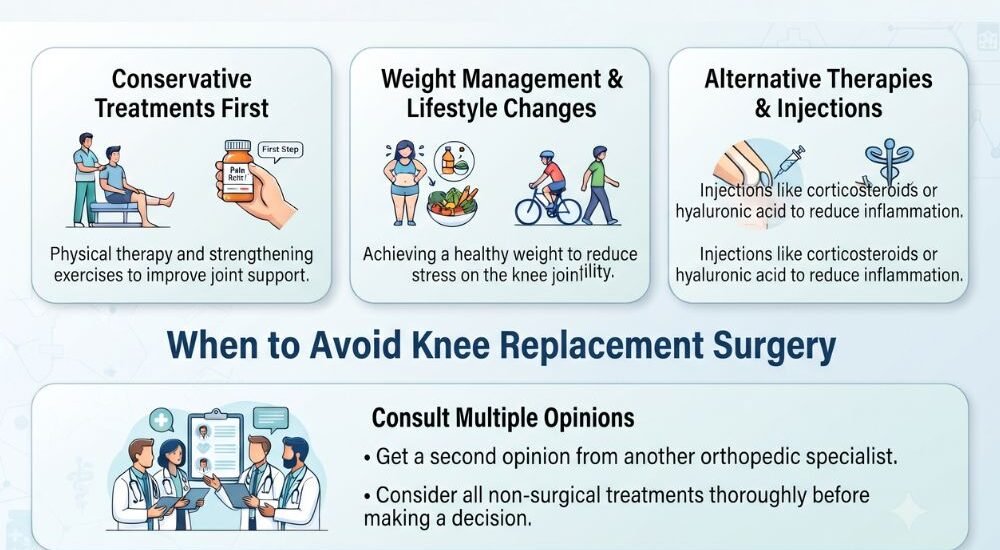
5 Reasons When to Avoid Knee Replacement Surgery?
Knee replacement surgery is one of the most successful procedures for treating severe knee arthritis and chronic joint pain. However, contrary to popular belief, not every patient with knee pain or advanced arthritis needs knee replacement surgery.
As an experienced orthopedic and joint replacement surgeon, I believe that surgery should always be the last option—not the first. A thorough evaluation helps determine whether a total knee replacement is truly necessary or whether other treatments can provide better results.
Here are the five situations where I do not recommend knee replacement surgery.
1. Severe Arthritis Without Significant Impact on Daily Life
Many patients believe that a Grade 4 arthritis diagnosis automatically means they need surgery. However, X-ray findings alone should never determine the need for knee replacement.
If you have Grade 4 knee arthritis but can:
- Walk comfortably
- Sleep without significant pain
- Perform your daily activities without major limitations
then surgery may not be necessary.
Some people experience surprisingly little pain despite advanced arthritis. This is often because they maintain:
- Strong leg muscles
- A healthy body weight
- An active lifestyle
- Proper nutrition
- Regular medical care and prescribed medications
In such cases, conservative management can continue to provide good quality of life.
2. When the Knee Is Not the Real Source of Pain?
One of the most commonly overlooked causes of knee pain is referred pain.
Sometimes the pain felt in the knee actually originates from another part of the body, such as:
- Hip arthritis
- Lumbar spine problems
- L3-L4 nerve compression (sciatica)
In these cases, the knee itself may appear completely normal on an X-ray, yet the patient experiences significant discomfort.
Performing a total knee replacement in this situation will not solve the problem because the actual source of pain remains untreated.
A detailed orthopedic evaluation helps identify whether the pain is coming from the hip, spine, or knee, ensuring that treatment targets the real cause.
3. When Non-Surgical Treatments Haven't Been Fully Tried
Knee replacement surgery should always be the last resort.
Before considering surgery, every patient should first receive the full benefit of conservative treatment options, including:
- Physiotherapy
- Weight management
- Lifestyle modifications
- Pain management strategies
- Orthobiologic injections (when appropriate)
- Doctor-recommended medications
Weak muscles, obesity, and poor rehabilitation can negatively affect surgical outcomes.
Even after surgery, patients who skip physiotherapy or fail to improve their overall health often struggle to achieve the best possible results.
That is why a complete trial of non-surgical treatment is essential before recommending knee replacement.
4. When Expectations From Surgery Are Unrealistic
A successful knee replacement surgery significantly reduces pain and improves mobility—but it does not restore your knee to its original, youthful condition.
Some patients expect that after surgery they will:
- Run like they did in their twenties
- Sit in deep squatting positions comfortably
- Perform every activity without restrictions
Unfortunately, these expectations are unrealistic.
An artificial knee can greatly improve your quality of life, but it will never function exactly like a natural joint.
The primary benefits of knee replacement include:
- Significant pain relief
- Improved walking ability
- Better knee alignment
- Enhanced day-to-day mobility
Patients should understand both the benefits and the limitations before deciding on surgery.
5. Active Infection or Uncontrolled Diabetes
One of the most important reasons to postpone knee replacement surgery is the presence of an active infection anywhere in the body.
Examples include:
- Chest infections
- Skin infections
- Urinary tract infections (UTIs)
Joint replacement requires an infection-free environment because bacteria can infect the artificial implant, leading to:
- Persistent pain
- Repeat surgeries
- Implant failure
- Long recovery periods
Similarly, uncontrolled diabetes significantly increases the risk of postoperative infection and delays healing.
For this reason, diabetes should always be brought under control before planning knee replacement surgery.
Final Thoughts
Total knee replacement is an excellent procedure for carefully selected patients, but it is not the right solution for everyone.
As an orthopedic surgeon, my priority is not simply performing surgery—it is helping patients achieve the best possible long-term outcome.
If your daily life is not significantly affected, your pain is coming from another source, conservative treatments have not been exhausted, your expectations are unrealistic, or you have an active infection or uncontrolled diabetes, knee replacement should be delayed or avoided.
The best treatment plan is always based on a comprehensive evaluation, accurate diagnosis, and a personalized approach. Remember, the goal is not just replacing a knee—it is improving your quality of life safely and effectively.
── Common Questions
Frequently Asked Questions
How do I know if I really need knee replacement surgery?
You may need knee replacement surgery if you have severe knee arthritis that causes persistent pain, limits your daily activities, affects your sleep, and does not improve with medications, physiotherapy, weight management, or other non-surgical treatments. A detailed evaluation by an orthopedic surgeon is essential before making the decision.
Can I avoid knee replacement surgery if I have Grade 4 arthritis?
Yes. Having Grade 4 knee arthritis on an X-ray does not always mean surgery is necessary. If you can walk comfortably, sleep well, and maintain a good quality of life with conservative treatment, knee replacement may not be required.
Why does my knee hurt even when the knee X-ray looks normal?
Knee pain can sometimes be caused by referred pain from the hip or lower back, such as hip arthritis or lumbar spine problems (sciatica). In these cases, the knee joint may be healthy, and treating the actual source of pain is more effective than knee surgery.
What non-surgical treatments should I try before knee replacement?
Before considering total knee replacement, most patients should try non-surgical treatments such as physiotherapy, weight management, pain-relieving medications, lifestyle modifications, activity adjustments, and, in selected cases, orthobiologic or other injection therapies. These approaches can significantly reduce pain and improve function.
Is FibreTaCan diabetes or an infection delay knee replacement surgery?pe Internal Brace suitable for everyone?
Yes. Active infections, such as skin, chest, or urinary tract infections, should be completely treated before surgery. Likewise, uncontrolled diabetes increases the risk of infection and delayed healing after knee replacement. Surgeons usually recommend proceeding with surgery only after these conditions are properly managed.
Ready to discuss your Knee Replacement options with our team?