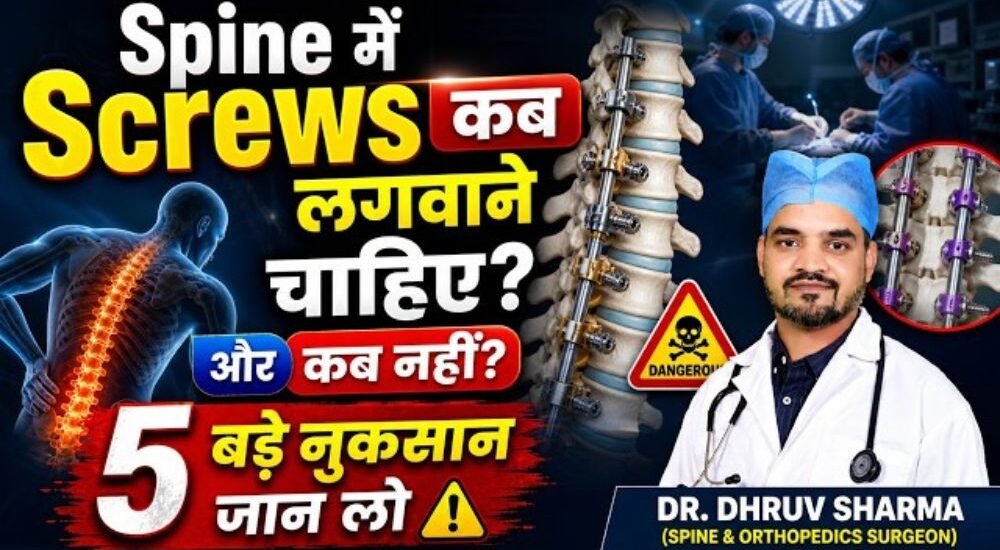
When are spinal screws necessary? —and When You Can Avoid Them
Not every back problem needs spinal screws. In fact, for many common conditions like slipped discs and spinal stenosis, modern minimally invasive techniques can relieve pain and nerve pressure while preserving your spine’s natural .
Below is a structured, easy to understand guide based on the approach of Dr. Dhruv Sharma, an AIIMS trained spine and orthopedic surgeon who leads Narayan Spine and Joint Institute.
The Core Principle: Preserve Motion Unless Stability Is Absolutely Required
Dr. Sharma’s guiding belief is simple: don’t put screws in the spine unless it’s truly necessary.
- The spine is designed to move—forward, backward, and side to side.
- Screws and fusion permanently lock a segment, eliminating motion at that level.
- For many degenerative problems (e.g., disc herniation, stenosis), the spine is already stable; the issue is nerve compression, not instability.
So the question isn’t “Are screws good or bad?” It’s: “Am I the right candidate for screws?”
When Screws (and Fusion) Are Essential?
There are clear, evidence based situations where instrumentation is lifesaving or function saving:
- Spinal fractures that threaten stability or the spinal cord
- Significant instability (e.g., spondylolisthesis with slip progression)
- Deformity correction such as scoliosis or kyphosis
- Certain tumor or infection cases requiring stabilization after decompression
In these scenarios, screws help restore alignment, protect nerves, and allow safe healing.
When Screws May Be Avoided: The Minimally Invasive Alternative?
For common conditions like slipped (herniated) discs and lumbar/cervical stenosis, many patients can be treated with:
- Endoscopic spine surgery(keyhole decompression)
- Microscopic decompression
- Targeted pain management procedures(injections, nerve blocks)
These approaches aim to remove the pressure on nerves with minimal muscle cutting, less bone removal, and no permanent hardware.
At Narayan Spine and Joint Institute, the team emphasizes endoscopic techniques for suitable cases to reduce tissue trauma and avoid unnecessary fusion.
When Screws May Be Avoided: The Minimally Invasive Alternative?
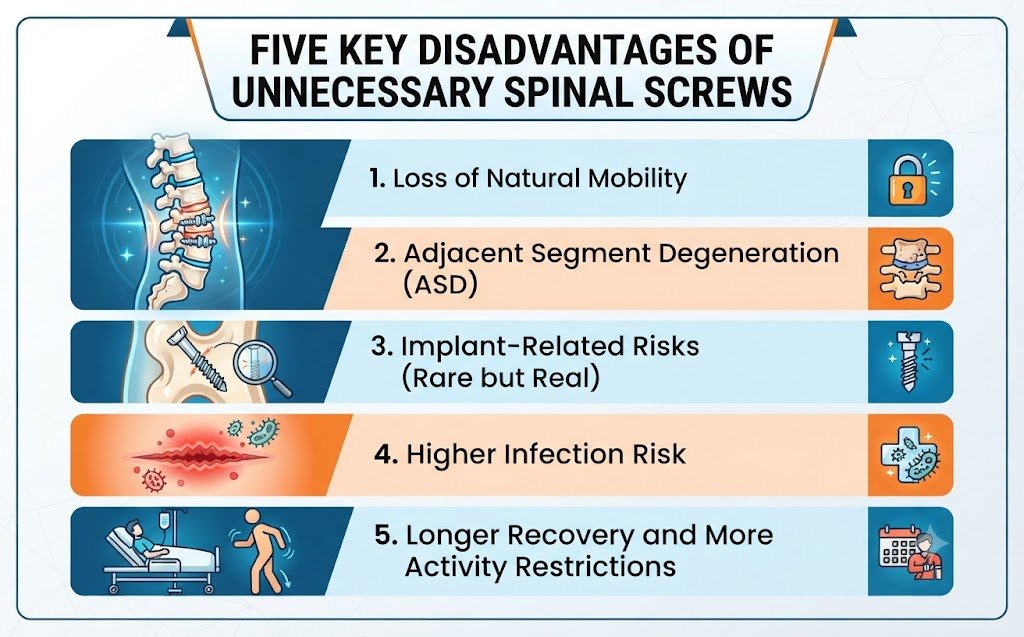
1) Loss of Natural Mobility (Permanent Stiffness at Fused Levels)
- Each spinal segment contributes a small amount of motion.
- When 2–4 levels are fused, that entire segment becomes rigid for life.
- Daily activities like bending forward, arching back, or twisting rely on cumulative motion—fusion reduces your total range permanently.
Plain language example: If four levels are fused, those four “hinges” stop working. Your body compensates by moving more at the levels above and below.
2) Adjacent Segment Degeneration (ASD): Extra Wear Above and Below
Fusion shifts mechanical stress to the neighboring discs and joints.
- Over time, this can accelerate wear at the levels next to the fusion.
- This is called adjacent segment degeneration/disease (ASD)and may cause new pain, stenosis, or even require another surgery.pmc.ncbi.nlm.nih+3
- Studies report radiographic ASD in a wide range (roughly 5–77%) and symptomatic ASD requiring re operation in about 0–27%, with higher risk after multi level fusions.nature+2
Bottom line: The more levels fused, the greater the long term stress on adjacent segments.
3) Implant Related Risks (Rare but Real)
Even with modern implants, there is a small chance of:
- Screw loosening or breakage
- Hardware irritation
- Low grade immune or inflammatory reactions
These are uncommon, but they’re avoidable if fusion isn’t needed in the first place.
4) Higher Infection Risk With Permanent Foreign Material
- Any implant is a foreign body.
- While surgical site infection rates are generally low, the presence of hardware can complicate management if infection occurs, sometimes requiring additional procedures or hardware removal.
- In contrast, endoscopic decompression without implants leaves no permanent foreign material behind.
5) Longer Recovery and More Activity Restrictions
Fusion requires bone to heal across the fused segment:
- Typical biological fusion time: about 3–9 months.
- Patients often wear braces, limit bending/lifting, and delay return to work for weeks to months.
- By comparison, many endoscopic decompressions allow walking the next day, with far fewer long-term restrictions and quicker return to routine.
When Screws May Be Avoided: The Minimally Invasive Alternative?
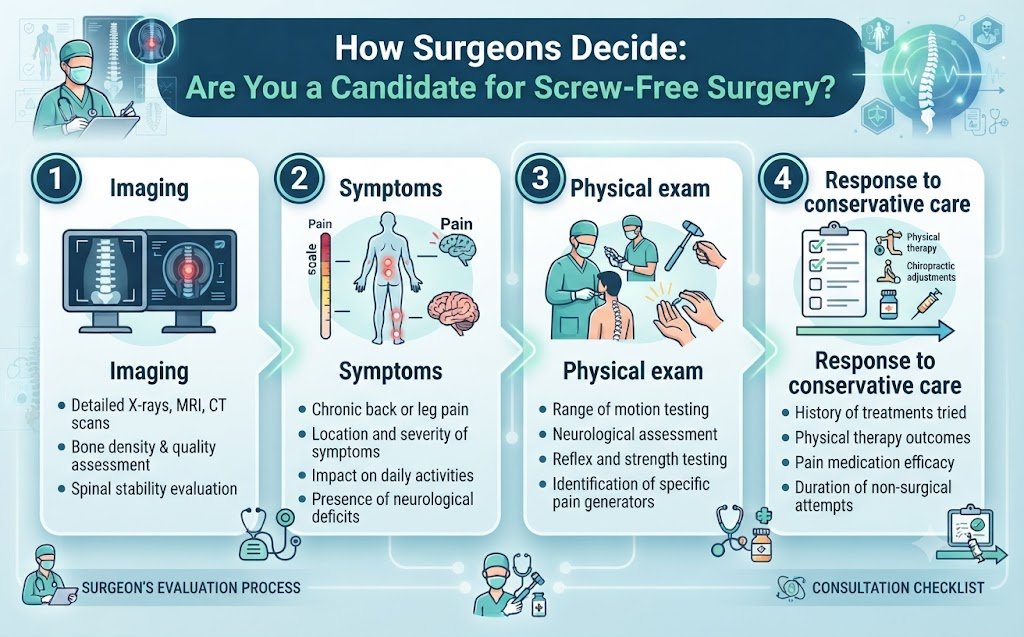
A careful evaluation helps match the treatment to the problem:
- Imaging:MRI/CT to confirm nerve compression vs. true instability.
- Symptoms:Leg pain, numbness, weakness, walking tolerance, bowel/bladder changes.
- Physical exam:Neurological deficits, dynamic instability signs.
- Response to conservative care:Medications, physiotherapy, injections.
If the spine is stable and the main issue is nerve compression, a decompression-only (endoscopic or microscopic) approach is often appropriate. If there’s proven instability or deformity, fusion with screws may be the safer, more durable option.
What This Means for You (Practical Takeaways)?
Don’t assume “bigger surgery = better result.” For many disc and stenosis cases, smaller, motion = preserving surgery works very well.
Ask your surgeon:
- Is my spine unstable, or is this mainly nerve compression?
- Can this be treated with endoscopic or decompression only surgery?
- If fusion is advised, how many levels and why?
- What is my personal risk of adjacent segment problems?
Seek a second opinion if fusion is recommended for a “simple” slipped disc without clear instability.
About Dr. Dhruv Sharma and His Approach.
Dr. Dhruv Sharma is a spine and orthopedic surgeon trained at AIIMS, New Delhi, with additional fellowships in endoscopic spine surgery and arthroscopy. He leads Narayan Spine and Joint Institute, which focuses on:narayanspineortho+1
- Endoscopic and microscopic spine surgeries
- Pain management and spine injections
- Joint preserving procedures, arthroscopy, and joint replacements (knee/hip)
His philosophy: treat the problem with the least invasive, most motion-preserving method that is still safe and effective.
When to Seek Immediate Care.
Regardless of surgical philosophy, get urgent medical attention if you have:
- New or worsening leg weakness, foot drop
- Loss of bowel or bladder control
- Severe, unrelenting pain with fever or after trauma
These can signal emergencies that need prompt evaluation.
If you’d like, share your MRI report wording (no images needed), your main symptoms, and what treatments you’ve tried—I can help you frame specific questions to ask your surgeon about screw free options.
── Common Questions
Frequently Asked Questions
Do all spine problems require screws?
No. Screws are mainly needed for fractures, instability, scoliosis, or spinal deformity. Many slipped discs and stenosis cases can be treated without screws.
Can a slipped disc be treated without spinal fusion?
Yes. If the spine is stable, endoscopic or minimally invasive decompression may relieve nerve pressure without fusion.
What is the main disadvantage of spinal screws?
Screws permanently fix the treated spinal segment, which can reduce natural movement and increase stress on nearby discs.
Do screws increase recovery time?
Fusion with screws usually requires a longer recovery because the bone needs time to heal. Screw-free endoscopic surgery may allow an earlier return to daily activities.
How do I know whether I need spinal screws?
Your spine surgeon will assess your MRI, X-rays, symptoms, and spinal stability. Ask whether decompression without fusion is a safe option for you.
Ready to discuss your spine pain treatment options with our team?