
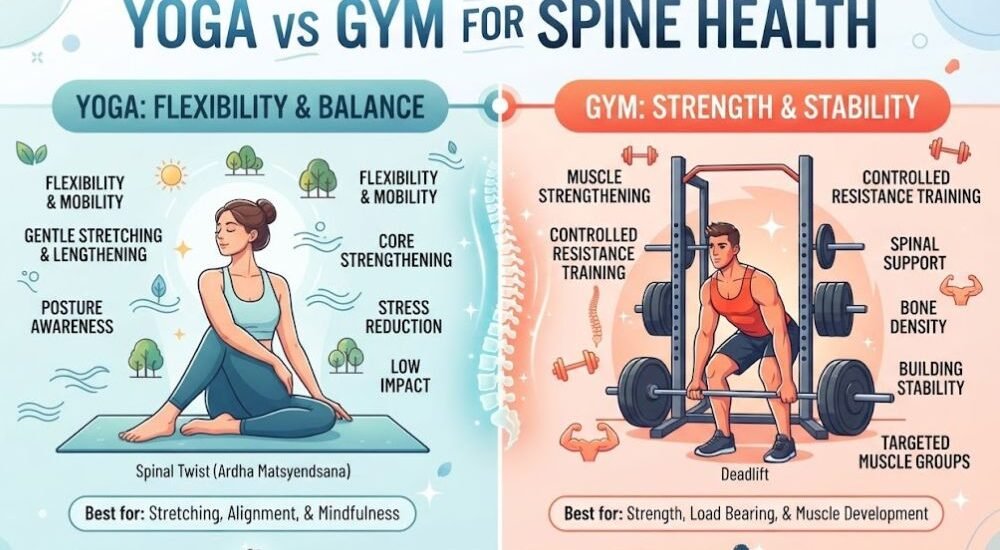
Yoga vs Gym for Spine Health: Which Exercise Is Better for Your Back?
If you suffer from back pain, you’ve probably wondered: should I do yoga or hit the gym? The truth is, both have benefits—but neither is perfect on its own. For optimal spine health, you need a balanced approach that builds both flexibility and strength.
Why Spine Health Needs Two Things: Mobility and Stability
Your spine must be both mobile (flexible enough to bend, twist, and turn) and stable (strong enough to support your body and handle load).
- Mobilityprevents stiffness and allows smooth movement in daily activities.
- Stabilityprotects your spine from injury when lifting, bending, or carrying weight.
Without mobility, you risk joint stiffness and muscle tightness. Without stability, you risk strain, disc issues, and facet joint problems.
Yoga: Great for Flexibility, Limited for Strength
Yoga excels at improving spine mobility through stretching and controlled poses. It helps:
- Increase range of motion in the spine
- Reduce muscle tension
- Improve posture and body awareness
However, yoga often lacks the progressive resistance needed to build significant spinal strength—especially for people who lift heavy objects at work or play high-impact sports.
Gym: Builds Strength, Often Neglects Stretching
Gym workouts are excellent for spine strengthening, especially with core and back exercises like deadlifts, rows, and planks. But many gym-goers skip proper warm-ups and stretching,
- Tight muscles
- Reduced spinal flexibility
- Higher injury risk during heavy lifts
Without adequate mobility, even strong muscles can’t protect your spine effectively.
The Ideal Solution: Pilates for Balanced Spine Care
Pilates uniquely combines both mobility and stability in one system.
- Core activation: Strengthening deep postural muscles that support the spine
- Controlled movement: Building strength through full range of motion
- Spinal alignment: Promoting neutral posture and reducing strainspine-health+1
Research shows Pilates can:
- Improve spinal flexibility and reduce stiffness
- Enhance trunk muscle endurance and balance
- Reduce lower back pain and correct poor posturewomen’s health
Unlike yoga or gym workouts that often emphasize one aspect over the other, Pilates inherently trains both—making it ideal for long-term spine health.
What Experts Recommend:
Spine specialists like Dr. Dhruv Sharma (AIIMS-trained orthopedic and spine surgeon) emphasize that the best exercise program addresses both flexibility and strength. At specialized centers like Narayan Spine and Joint Institute, Pilates-based “Muscle Reprogramming” systems are used to activate, strengthen, and stretch core spinal muscles simultaneously.
If you have chronic back pain, the first step is always a professional evaluation by a spine surgeon or physiotherapist. They can identify the root cause and recommend a tailored exercise plan—whether it’s yoga, gym, Pilates, or a combination.
Final Takeaway
For lasting spine health, don’t choose between yoga and gym—aim for balance. If you want one system that delivers both flexibility and strength, Pilates is your best bet. But always start with a professional evaluation to ensure you’re doing the right exercises for your specific condition.
── Common Questions
Frequently Asked Questions
Can yoga alone fix my back pain?
Yoga can help with mild back pain by improving flexibility and reducing stress. However, if your pain stems from weak core muscles or poor spinal stability, yoga alone may not be enough
Is going to the gym safe if I have back problems?
Yes—if done correctly. Focus on core-strengthening exercises with proper form, and always include stretching. Avoid heavy lifting without professional guidance.
Why is Pilates better than yoga or gym for spine health?
Pilates integrates both mobility and stability training in every session. It strengthens deep core muscles while improving spinal flexibility—addressing both key pillars of spine health.
How soon will I see results from Pilates for back pain?
Many people report reduced pain and improved movement within 6–8 weeks of consistent Pilates practice.
Should I consult a doctor before starting any exercise for back pain?
Absolutely. A spine specialist can diagnose the cause of your pain and rule out serious conditions like disc herniation or spinal stenosis before you begin any exercise program.
Ready to discuss your Spine Pain with our team?